


WordPress on DigitalOcean

Author: headless_sync

  • CPTED in Practice: How Environmental Design Prevents Incidents Before They Start

    CPTED in Practice: How Environmental Design Prevents Incidents Before They Start

    Most security conversations start with cameras and alarms: which brand, how many, where to mount them. A proper CPTED assessment starts earlier than that, with the physical design of the space itself, before a single piece of technology enters the conversation at all. It’s a different way of thinking about security, one that treats the building and the grounds as the first line of defence, not an afterthought around the equipment.

    What CPTED actually is

    Crime Prevention Through Environmental Design, commonly abbreviated CPTED and pronounced “sep-ted,” is built on a straightforward premise: the proper design and effective use of the built environment can reduce both the incidence and the fear of crime, while also improving overall quality of life for the people who use the space.

    It’s not a fringe theory. It’s a framework used by police services across Canada, including Edmonton Police Service, which runs multi-day CPTED Basic and CPTED Advanced training courses for practitioners, and RCMP detachments in communities like Prince George that offer community CPTED assessments for buildings, parks, and public spaces directly.

    The approach rests on four core, interconnected principles:

    • Natural surveillance: designing spaces so people and activity are naturally visible to one another, rather than hidden behind blind corners, dense landscaping, or poorly placed structures.
    • Natural access control: guiding how people move through a space using real and psychological cues, like pathways, lighting, and signage, so movement feels intentional rather than left entirely to chance.
    • Territorial reinforcement: design choices that signal a space is owned, watched, and cared for, which research consistently shows discourages opportunistic behaviour more effectively than signage alone.
    • Maintenance: because a well-kept property signals active oversight and discourages disorder, while broken fixtures, overgrown grounds, or unaddressed graffiti send the opposite signal, whether intended or not.

    Why it matters for institutional properties

    For municipalities, school boards, and larger commercial properties, CPTED isn’t a replacement for security technology or trained personnel, it’s the layer underneath both of them. A well-designed sightline means a camera actually has something worth seeing, instead of pointing at a wall of shrubbery. A well-lit, clearly defined entry point means access control has a natural chokepoint to work with, instead of fighting against a building’s original, often decades-old layout that was never designed with modern security needs in mind.

    Security industry practitioners are consistent on this point across the board: CPTED reduces opportunities for crime through thoughtful design, but it’s most effective when paired with active monitoring and a genuine physical response capability, not used as a stand-alone measure and left at that. The two approaches reinforce each other. Design reduces the number of situations that ever require a response in the first place; monitoring and response handle the situations that occur anyway.

    What a CPTED assessment looks like in practice

    A proper assessment is more grounded and practical than the theory might suggest:

    • A walk-through identifying where sightlines are blocked, whether by landscaping that’s grown in over the years, temporary signage, storage structures, or the building’s own architecture.
    • A review of movement patterns, looking at how visitors, students, staff, and vehicles are guided, or in many cases, not guided at all, through the property, and where that ambiguity creates opportunity.
    • Recommendations that are often lower-cost than property managers expect. Trimming sightline-blocking vegetation, repositioning a light fixture, or redesigning a single entry point are frequently far cheaper than a major technology overhaul, and often solve problems technology alone can’t.
    • Integration with existing or planned camera and access control systems, so the environmental design work and the technology reinforce each other rather than operating as two disconnected projects handled by different teams at different times.
    • A maintenance plan, because CPTED isn’t a one-time fix. A property that’s assessed once and never revisited will drift back toward its original vulnerabilities as landscaping grows, lighting degrades, and use patterns change.

    Certified expertise, applied locally

    Security ONE’s Security Consultants are CPTED-trained, and have applied this approach across institutional clients throughout Southern Ontario, bringing an understanding of how these principles translate to real buildings with real usage patterns, not just textbook examples. Centralized intelligence. Custom design. Certified professionals. The same expertise that protects federal assets, applied to your property, starting with the ground it sits on.

    For institutional decision-makers evaluating where to invest security budget, a CPTED assessment is often the highest-value starting point precisely because it identifies what technology alone would miss.

    See what a CPTED assessment would find on your property. Request a complimentary consultation with one of Security ONE’s CPTED-trained Security Consultants. We’ll identify where environmental design, not just equipment, can close the gaps.

  • One App, Every Location: Managing Multi-Site Access Control as You Expand

    When a business opens with a single site, it’s completely reasonable to manage access with something simple: a shared code everyone knows, a set of physical keys handed out as needed, maybe a basic alarm panel with one master code. That approach works fine, right up until there’s a second address to think about.

    Suddenly the owner is tracking who has keys to which building, whether the alarm codes are the same across both locations or different, and how they’d even find out if something happened at the site they’re not currently standing in. Simple systems make sense for simple operations. It’s just a natural growing pain, one that’s far easier to solve deliberately, with a plan, than to patch together reactively as problems come up one at a time.

    The most common version of this problem shows up a few months after the second location opens, once the initial excitement settles and the owner realizes they’re now checking two separate alarm apps, keeping two separate mental lists of who has access to what, and hoping nothing falls through the gap between them.

    What integrated access control actually solves

    An integrated system built around one app for alarm, access control, and video changes the operational picture in a few concrete, practical ways:

    • Centralized credentials. Add or remove an employee’s access from any location, from one single place, the moment they’re hired or the moment they leave.
    • Location-specific visibility. Check camera feeds or alarm status at any site without needing separate logins, separate apps, or separate hardware for each address.
    • Consistent monitoring standards. Every location gets the same level of AI-powered monitoring and human review, not a stronger system at the flagship store and a weaker one at the newer location.
    • Faster, standardized response. If something is flagged at any site, the same monitoring team responds the same way, with the same protocols, regardless of which address the alert is coming from.
    • Simplified reporting. Owners managing multiple sites can see activity patterns across all of them in one place, making it far easier to spot something unusual that would be invisible if each site’s data lived in a separate system.

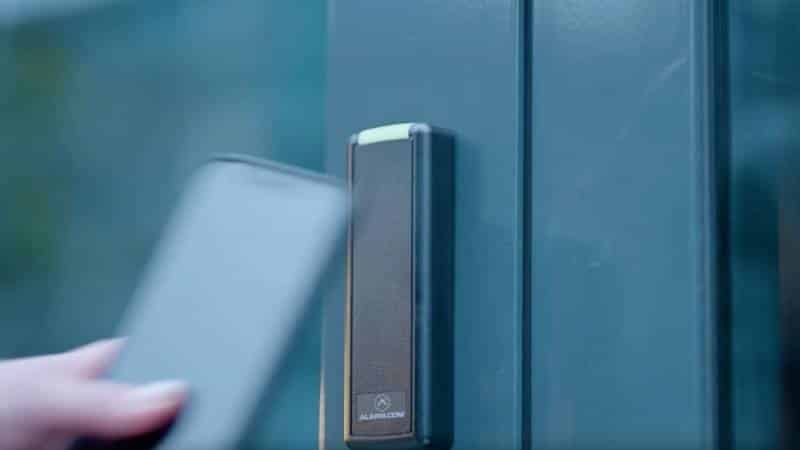
    access control for business with mobile credentials

    Designed for the way small businesses actually grow

    This isn’t an enterprise-only capability reserved for large chains with dedicated security departments. It’s built specifically for the small business owner who’s opening a second or third location and doesn’t want security to become an unofficial part-time job layered on top of actually running the business. Local Experts. Intelligent Systems. That combination matters here: the technology does the heavy lifting of centralizing everything, and a real local team is behind it when something needs a human response.

    A lot of owners don’t think about this until after the second location is already open and the cracks start to show. If you’re planning an expansion this fall, it’s worth having a conversation with a Security ONE consultant before the second site opens rather than after, so the system is designed to scale with the business from day one.

    Growth should feel like progress, not like an administrative burden multiplying with every new address. The right access control setup is the difference between the two.

    Opening a second location? Let’s design it right from day one. Book a free consultation with a Security ONE consultant before your next site opens. We’ll build one integrated system for every location, so growth never means more to manage.

  • Why Fall Is Break-In Season for Small Businesses (And What To Do About It)

    Why Fall Is Break-In Season for Small Businesses (And What To Do About It)

    What the data shows

    Insurance industry data covering 2015 to 2024 shows burglary claims running consistently higher between July and November than the rest of the year, with August standing out as the single peak month at nearly one in ten annual burglary claims. That elevated window doesn’t drop off sharply after August, it extends well into fall, covering exactly the period many small businesses are moving through right now.

    At the national level, Statistics Canada reported 121,033 breaking-and-entering incidents across Canada in 2024. While the national rate has been declining for years, down 11% from 2023 and nearly a third lower than a decade ago, it still accounts for 13% of the overall Crime Severity Index, more than any other single offence category tracked. Declining rates are genuinely good news, but they don’t mean the seasonal pattern has disappeared.

    Local, granular data backs up the seasonal pattern with specifics that matter for planning. An open-data analysis of break-and-enter incidents in Oakville between April 2024 and August 2025 found that shops and businesses accounted for roughly a quarter of all reported break-ins in the region, second only to residential homes. The same dataset found that overnight and early morning hours, midnight to 8am, made up the bulk of incidents, exactly the hours a small business is closed, unattended, and often unmonitored by anyone physically present.

    Why fall specifically hits small businesses

    A few factors compound around this time of year, often at the same time:

    • Shorter daylight hours mean more of a business’s closed hours happen in full darkness, extending the window where a property sits both closed and hard to see clearly from the street.
    • Staffing and schedule changes, students returning to school, seasonal hires ending their contracts, can create real gaps in who’s checking on the property after hours.
    • Increased inventory for fall and the approaching holiday season means more value sitting on-site overnight, right as the seasonal risk window is already elevated.
    • Routine complacency. A business that made it through a quiet summer without incident can understandably let its guard down slightly, exactly when the data suggests the opposite is warranted.

    A practical response, not a reactive one

    The goal isn’t to react after an incident happens, it’s to make your business a harder, less appealing target before anything happens at all. A few concrete steps:

    • Confirm exterior lighting covers all entry points, not just the front door facing the street. Side entrances, loading docks, and rear alleys are disproportionately where overnight incidents occur.
    • Review after-hours camera coverage for blind spots around loading docks, side entrances, and any area added or changed since the cameras were originally installed.
    • Make sure your alarm system’s monitoring schedule matches your actual closing hours, especially if they’ve changed for the season.
    • Consider a CPTED-style walk-through of your property with a security consultant to identify overlooked vulnerabilities, blocked sightlines, poor lighting placement, or access points that have quietly become weak spots over time.
    • Check in with neighbouring businesses. A quick conversation about who’s watching what after hours can catch gaps that neither business noticed on its own.

    The advantage of intervention, not just recording

    A camera that only records footage tells you what happened after it’s already too late to do anything about it. That’s useful for insurance claims and police reports, but it doesn’t actually prevent the loss. AI-powered monitoring, reviewed by a real person, is designed to catch the door that shouldn’t be open, or the person who shouldn’t be there, while it’s happening, not the next morning when someone opens up and finds the damage already done.

    Most systems alert you after a break-in. We detect, verify, and intervene before it happens. For a small business heading into the elevated-risk stretch of the year, that distinction is the entire point.

    Get ahead of the season’s elevated risk. Book a free on-site security consultation with Security ONE. We’ll review your after-hours coverage, lighting, and alarm schedule so your business isn’t an easy target this fall. 


  • Shorter Days, Higher Risk? What Actually Happens to Crime When It Gets Dark Earlier

    Shorter Days, Higher Risk? What Actually Happens to Crime When It Gets Dark Earlier

    What the research shows

    The clearest evidence on this comes from studies of daylight saving time, which effectively run a natural experiment on ambient light each year without changing anything else about a given city or population.

    Economists Jennifer Doleac and Nicholas Sanders analyzed crime patterns around the time change and found that robbery rates increase by roughly 7% overall when clocks “fall back” in November, driven mostly by a striking 27% jump in robberies specifically during the evening hour that shifts from light to dark. Interestingly, their research found no equivalent effect in the early morning hours that also gain darkness, which lines up with a simple observation: most burglaries and street crimes happen when people are out and about, not when they’re still asleep.

    A separate 2015 Brookings Institution analysis reached a similar conclusion from a different angle, estimating that eliminating the twice-yearly clock change and keeping evening daylight year-round could reduce robberies by as much as 27% directly, simply through the deterrent effect of visibility. The researchers’ explanation is intuitive: offenders know they’re more likely to be recognized and caught if they’re clearly visible, so more daylight during the hours people are commuting, walking, or out running errands translates into less opportunity.

    It’s worth being upfront that this research is largely U.S.-based. Canada doesn’t currently have an equivalent large-scale study isolating the same effect using Canadian crime data. But the underlying logic, that visibility affects opportunity, and opportunity affects behaviour, isn’t specific to one country or one reporting system. It’s a reasonably safe assumption that the same basic dynamic applies here.

    What this means practically, not fearfully

    This isn’t a reason to feel unsafe walking to your car in October, or to avoid being outside once the sun sets earlier. The vast majority of evenings, for the vast majority of people, are perfectly uneventful regardless of what time it gets dark. It is, however, a reasonable prompt to make a few small, genuinely low-effort adjustments:

    • Exterior lighting on timers, so entry points and walkways aren’t sitting in the dark by 6:30pm just because nobody remembered to flip a switch.
    • Motion-activated lights near driveways, side entrances, and anywhere a person might approach your home without walking past a well-lit front door.
    • A quick walk around your property at dusk, once a week or so through the fall, to see what an outside observer would actually see. It’s a five-minute habit that catches burned-out bulbs and overgrown shrubs blocking a light fixture before they become a real gap.
    • A look at your daily routine, noticing which parts of your commute or errands now happen in the dark that didn’t a month ago, and adjusting small habits accordingly.

    Where monitoring adds the missing piece

    Lighting helps, and it’s genuinely one of the most cost-effective deterrents available to any homeowner. But lighting doesn’t watch your property when you’re not looking at it yourself. AI-powered monitoring does that continuously, day or night, and when something looks off, a real local monitoring agent reviews it immediately, not after the fact once the damage is already done.

    Prevention. Not just detection. That’s the actual difference between a system that tells you something happened and one that’s working to make sure it doesn’t.

    You don’t need to overhaul anything for the change of seasons. You just need a system that adjusts with you, quietly, in the background, the same way it does every other month of the year.

    A darker evening shouldn’t mean a less secure home. Talk to a Security ONE consultant for a free home security consultation. We’ll look at your lighting, entry points, and monitoring together, so the season change works with you, not against you.